
Let’s get to know the Galgo breed!
Hello everyone, and welcome back!
After living with Terence for a year and a half, we’ve learnt a great deal about him and his breed. Today we’d like to share some of what we’ve discovered.
Galgos are sensitive, calm and quiet greyhounds. They communicate through their posture, body language and subtle cues, such as calming signals or licking their lips, which are easy to miss at first. Given their past, they need to be treated with calm and respect: they are very sensitive to being pushed too hard, and they let you know in their own way.
We won’t go into detail about every aspect of their communication, but we’ll draw a parallel between the first language we encountered, that of fear and stress, and the one we’ve learnt to bring out: joy and happiness.
The language of fear and stress
When Terence arrived, we were quite at a loss. We knew the basics – a tail tucked between the legs means fear, we all know that, but we were completely unprepared for everything else. We realised this straight away on the first day: Terence had a nasty wound on his tail and we had to take him to the vet. When we got there, we noticed that his nose was running. We asked, a bit worried, and the vet calmly explained that this is absolutely normal for greyhounds: when they feel uncomfortable or are in a stressful situation, their nose starts to run. Something we’d never heard of before.
Another sign we learnt to recognise almost immediately is ‘statue syndrome’. Having come from a different environment, Terence was afraid of a great many sounds and would freeze, motionless and immovable, refusing to take another step. With calm and a great deal of patience, we managed to handle these moments, which still occur from time to time. Added to all this is the language of the ears. In moments of distress, they flatten against his head, as if he wanted to make himself small, invisible, out of danger.
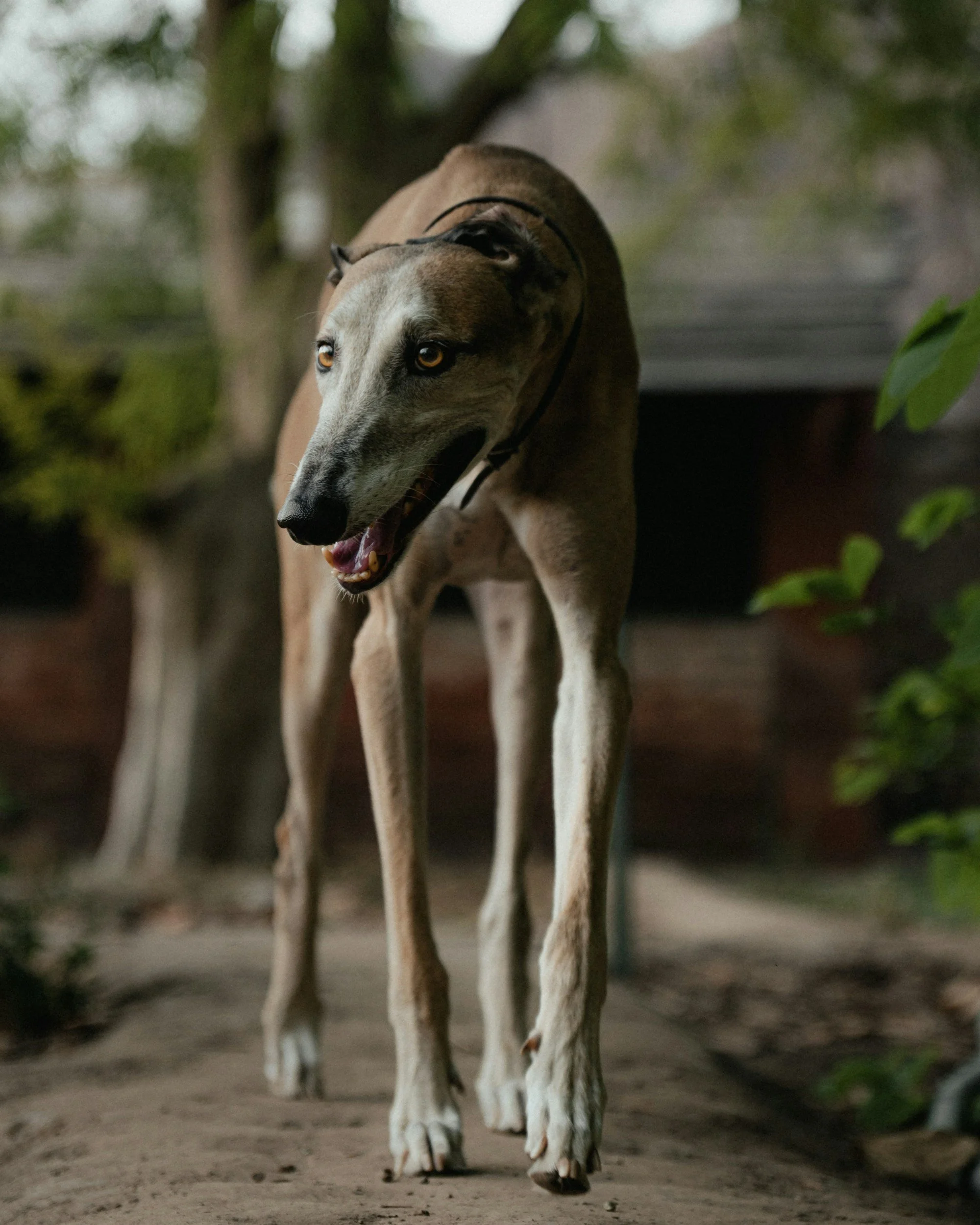
Body language says it all!
Pay attention to their body language and you’ll get to know your dog better.
The language of joy and happiness
If a runny nose has taught us to recognise distress, his tail has taught us to recognise joy. When Terence is happy, his tail curls upwards into a hook, wags like a helicopter, and moves rapidly. It’s his way of telling us he’s fine, that he’s happy. Once you know this, you can’t help but look for it.
Another thing that surprised us the first time we heard it was his howl. When we call Terence in a cheerful tone, he responds, not with a normal bark, but with a long, melodious howl that almost sounds like a sung reply. At first, it took us aback. Then we realised that this is his way of joining in, of saying, “I’m here, I can hear you, I’m happy.”
The same ears that flatten against his head when he’s scared, perk up when Terence is calm and curious. They’re called ‘ravioli ears’ because of their soft, folded shape, and when he’s happy they flare outwards, as if he wants to take in everything around him.
Even though we’re getting to know him better and better, Terence still manages to surprise us. He loves to curl up next to us under the blankets, and when he’s really happy, he gives us little nibbles on the arms. It’s a tender and unmistakable gesture: his way of telling us he loves us.

Learning to observe
It’s an opening a window onto a world you never knew existed.
Along this journey, we have realised that Terence, and all rescue greyhounds, have a great deal to say and teach. Not only through body language, but also on an emotional level. They are strong and gentle at the same time, resilient and open to new experiences, if you give them time to adapt and respect their own pace.
Learning to observe them is like opening a window onto a world you never knew existed.
Conosciamo la razza dei Galgo!
Il linguaggio del corpo dice tutto
Buongiorno a tutti e bentrovati!
Dopo un anno e mezzo di convivenza con Terence, abbiamo imparato tantissimo su di lui e sulla sua razza. Oggi vogliamo condividere qualcosa di quello che abbiamo scoperto.
I Galgo sono levrieri sensibili, pacati e silenziosi. Comunicano attraverso la postura, la gestualità e piccoli segnali, come i segnali di calma o il leccarsi le labbra, che all'inizio è facile non notare. Considerando il loro passato, hanno bisogno di essere trattati con calma e rispetto: sono molto sensibili alle forzature, e lo fanno sapere a modo loro.
Non entreremo nel dettaglio di tutti gli aspetti comunicativi, ma faremo un parallelismo tra il primo linguaggio che abbiamo conosciuto, quello della paura e dello stress, e quello che abbiamo imparato a tirare fuori: la gioia e la felicità.
Il linguaggio della paura e dello stress
Quando Terence è arrivato, eravamo parecchio spaesati. Conoscevamo le basi, la coda tra le gambe significa paura, questo lo sappiamo tutti, ma su tutto il resto eravamo impreparati. Il primo giorno lo abbiamo capito subito: Terence aveva una brutta ferita alla coda e dovevamo portarlo dal veterinario. Quando siamo arrivati, abbiamo notato che gocciolava dal naso. Abbiamo chiesto, un po' preoccupati, e il veterinario ci ha spiegato con calma che per i levrieri è assolutamente normale: quando si sentono a disagio o in una situazione di stress, il naso inizia a gocciolare. Una cosa che non avevamo mai sentito nominare.
Un altro segnale che abbiamo imparato a riconoscere quasi subito è la sindrome della statua. Essendo arrivato da un ambiente diverso, Terence aveva paura di moltissimi suoni e si bloccava, immobile, inamovibile, rifiutando di fare un altro passo. Con calma e tanta pazienza siamo riusciti a gestire questi momenti, che ogni tanto si presentano ancora. A tutto questo si aggiunge il linguaggio delle orecchie. Nei momenti di disagio si appiattiscono contro la testa, come se volesse farsi piccolo, invisibile, fuori pericolo.
Il linguaggio della gioia e della felicità
Se il naso che gocciola ci ha insegnato a riconoscere il disagio, la coda ci ha insegnato a riconoscere la gioia. Quando Terence è felice, la coda si piega verso l'alto formando un uncino, si muove come un elicottero, scodinzola veloce. È il suo modo di dirci che sta bene, che è contento. Una volta che lo sai, non riesci più a non cercarlo con gli occhi.
Un’altra cosa che ci ha stupito la prima volta che lo abbiamo sentito è stato l'ululato. Quando chiamiamo Terence con un tono allegro, risponde, non con un normale abbaio, ma con un ululato lungo e melodioso che sembra quasi una risposta cantata. All'inizio ci ha spiazzati. Poi abbiamo capito che è il suo modo di partecipare, di dire "ci sono, vi sento, sono felice.”
Le stesse orecchie che si appiattiscono per la paura, si aprono quando Terence è sereno e curioso. Le chiamano "a raviolo" per via della loro forma morbida e ripiegata, e quando è felice si aprono verso l'esterno, come se volesse raccogliere tutto quello che lo circonda.
Nonostante lo conosciamo sempre meglio, Terence riesce ancora a stupirci. Adora appallottolarsi vicino a noi, sotto le coperte e quando è davvero felice ci regala dei piccoli morsetti sulle braccia. Un gesto tenero e inequivocabile: il suo modo di dirci che ci vuole bene.
In questo percorso abbiamo capito che Terence, e tutti i levrieri rescue, hanno molto da dire e da insegnare. Non solo attraverso il linguaggio del corpo, ma anche a livello emotivo. Sono forti e delicati allo stesso tempo, resilienti e aperti alle novità, se gli si lascia il tempo di adattarsi e si rispettano i loro ritmi.
Imparare ad osservarli è come aprire una finestra su un mondo che non sapevi esistesse.